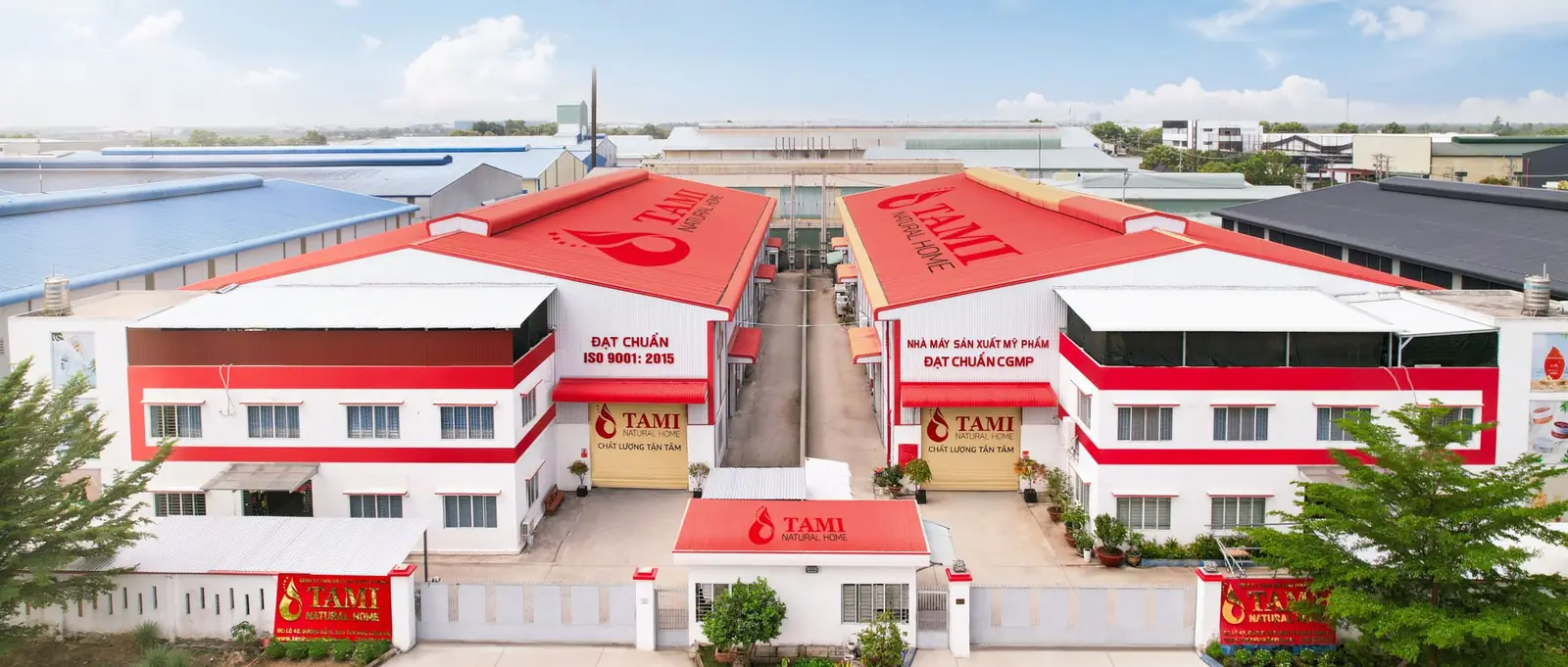
The question buyers ask most is not "can you make it" but "does this actually count as Vietnamese". This page covers the plant location, origin rules, how access differs across three markets, and exactly what the China-side team does. We do not print specific tariff rates — they move, and only a line-by-line HS lookup counts.
Where the plant is, and who runs it FACTS
| Where it is made | Lot 48, Tan Duc IP, Tay Ninh, Vietnam; in-house steps, bought-in items and any subcontracted work are confirmed project by project |
|---|---|
| Plant & lines | Built to CGMP standards, mainly filling and packing lines; emulsifying tanks 14.9 t per batch |
| Port of export | FOB Cat Lai (Ho Chi Minh City) |
| Certificates | ISO 9001:2015 (749435) · CGMP-ASEAN (912/GCN-QLD) · US FDA facility registration (FEI 3030839348, registration has since expired) |
| China-side role | Sales, quoting, technical and content — no production step. There is no "made in China, relabelled in Vietnam" path here. |
What actually counts as Vietnamese origin ORIGIN RULES
Filling alone does not change the HS code. Shipping finished bulk from China into Vietnam to be bottled usually does not constitute substantial transformation — to US CBP it is still Chinese origin. We do not take that route.
Substantial transformation needs at least three things: the bulk is compounded in Vietnam (not imported ready-made), packaging is local or third-country (Vietnam self-supply is thin — this is the biggest lever), and the BOM and process are traceable.
We do not guarantee clearance on your behalf. Origin is determined by the importing customs authority, not the factory. What we provide is process records, BOM, COO and test reports for your declaration.
How access differs across three markets MARKETS
| Market | Tariff structure | Compliance route | What we can provide today |
|---|---|---|---|
| ASEAN (Thailand / Philippines / Malaysia / Vietnam) | Preferential treatment under ATIGA | ASEAN Cosmetic Directive framework; national notification differs by country. Indonesia additionally requires MUI Halal certification | CGMP-ASEAN, COA, COO; Indonesian orders not taken — that certification is not held yet |
| European Union | 97% of categories move to zero duty under EVFTA | CPNP notification + CPSR safety report + EU responsible person | CGMP-ASEAN, COA, test reports; CPNP / CPSR / responsible person must be handled by the importer or its agent |
| United States | MFN rate plus Section 301 and other additional measures (rates change — verify HS line by line) | MoCRA facility registration and product listing; sunscreen falls under drug rules | FDA facility registration (FEI 3030839348 — a filing, not an approval, and since expired), COA; we do not take sunscreen orders |
The tariff column gives structure only, not numbers. Send an HS code for specifics.
Frequently asked 5 Q&A
- Does this count as Vietnamese origin?
- It depends on what goes in. Substantial transformation requires the bulk to be compounded in Vietnam, packaging sourced locally or from a third country, and a traceable BOM. "Chinese bulk, Vietnamese filling" does not qualify — we decline those orders.
- Is the China side a factory or a trader?
- Sales, quoting and technical support only — **no production line**. Compounding, filling and QC all happen at the Tay Ninh plant, and you can verify by video at any time.
- Why no specific tariff rate?
- Rates move (in February 2026 the US Supreme Court struck down the IEEPA reciprocal tariffs, with Section 301 additional duties following). Printing a number is a landmine. Send your HS code and we will check the current rate line by line.
- EU customer — who handles CPNP and CPSR?
- The importer or its EU-based responsible person; regulation requires a responsible person inside the EU and a factory cannot substitute for one. We supply the ingredient list, safety data, CGMP certificate and test reports for the dossier.
- Can you issue a certificate of origin?
- Yes, a COO. Note that a COO only proves export from Vietnam — it does not guarantee the importing customs authority will grant preferential treatment. That depends on substantial transformation.