
Working Out Cosmetics OEM MOQ: From 100 kg to 10,000 Units
Three pricing bases coexist inside one plant: kilos of bulk, finished units, and quoted per formula. Spread across 15 categories, the lowest floor is 100 kg for skincare and the highest is 10,000 units for hand care. This piece covers what each one is counted in, how the conversion actually works, and the three moves left when your volume sits below the floor.
Three bases first: kilos, units, quoted per formula
The 15 categories are not measured with one ruler, and that decides what you have to answer before "what is your MOQ" means anything.
Counted in kg: baby care, skincare, the wash-and-clean group (body care, hair care, home care) and makeup remover. The emulsifying tanks are charged by weight, so the floor sits on the bulk; packing is a downstream step and changing a bottle or carton does not move the minimum batch.
Counted in units: fragrance, men’s fragrance, the whole pet care line, cleanser and hand care. Bottle and closure are already inside the quote, so the figure you get is finished pieces.
Home fragrance and intimate care are quoted per formula and pack: bottles and bulk vary too widely inside those categories for one number to be honest.
The three cannot be compared side by side. 100 kg and 10,000 units are not the same order of magnitude — settle which basis your product falls on first.
Six bands: which one your category lands in
Read the basis first, then the number. Categories sharing a row share a floor.
| Basis | Categories | Floor |
|---|---|---|
| kg | Skincare | 100 kg |
| kg | Baby Care / Body Care / Hair Care / Home Care · makeup remover | 1,000 kg |
| units | Fragrance / Men Fragrance | 2,000 units |
| units | Pet Fragrance / Odour Remover / Coat Spray / Shampoo | 2,000 units |
| units | Cleanser (face wash) | 5,000 units |
| units | Hand Care | 10,000 units |
| Quoted per item | Home Fragrance / Intimate Care | quoted per formula and pack |
Cleanser and makeup remover carry two bases inside one category: face wash at 5,000 units, makeup remover at 1,000 kg. The full 15-category table is on MOQ & sampling.
What 2,000 units is in kilos: and why there is no fixed factor
The conversion is one multiplication: pieces × net fill per piece × density = bulk weight. You have the first two. You do not have the third — density follows the formula: water-based sits near 1, oil and powder phases push it away, and fragrance moves with concentrate level.
So we do not quote you a fixed factor. Tell us 30 ml at 15% concentrate and we work it out on the spot from your bottle and fill. Ask the reverse — "how many pieces is 100 kg" — and the answer still starts with the fill volume.
This is not evasion. The industry shorthand of "1 kg is about 4 bottles of fragrance" collapses the moment the formula changes. Budget on it and the gap that shows up is in your cash.
30 ml and 50 ml are two SKUs — the floor is per SKU
Confirmed in writing by the plant on 2026-10-28: the two fills are two separate SKUs, and MOQ plus tiered pricing must be quoted on separate lines. They are not added together.
The budget consequence is direct: launching both fills at once doubles the entry floor. Launch one, add the other once sell-through justifies it, and the entry cost halves.
The same applies to price tiers. The bands on a price list are a function of quantity per SKU, not of total order volume — quote two fills together and you will be given two low-band prices anyway.
What sampling costs in time and money
Sampling is the one stage where the commitment is complete and in writing: rounds, lead time and who pays shipping.
| Item | Terms |
|---|---|
| Stock samples | 1–3 pieces, free, shipped in 3–7 days |
| Custom samples | Made to the agreed formula. The sampling terms already agreed with you stand; up to three rounds are free for customers who have ordered from us before; for a new customer a sampling fee is confirmed with the quotation. |
| Custom sample lead time | 7–10 working days from formula and bottle confirmation |
| First bulk order | Lead time confirmed against your sealed sample and packaging readiness, then written into the order; repeat orders scheduled per run |
| International shipping | Outside Vietnam at the client’s cost; domestic leg we arrange |
| From round 4 | Charged per project, agreed case by case |
Free does not mean unlimited. Three rounds is the ceiling and round four is charged per project — saying so at the start beats raising it at round five.
The clock starts the day the formula is signed back, not the day you send the enquiry. Until that is settled the 7–10 working days has no start point. Bulk lead time is confirmed against your sealed sample and packaging readiness, then written into the order; repeat production, QC and shipping carry no fixed day counts until the slot is confirmed.
The floor will not come down, but it can be split
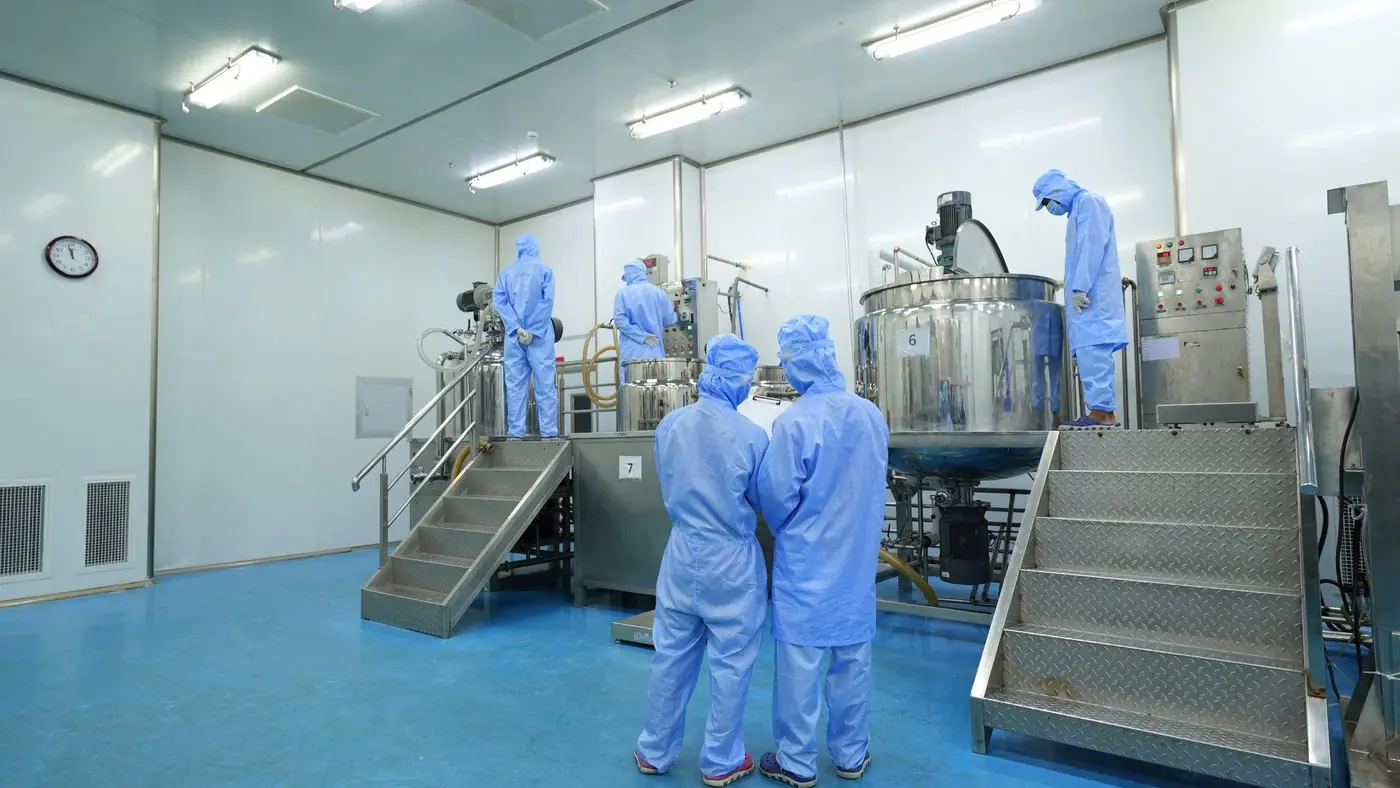
The floor is set by equipment, not by negotiation. Five emulsifying tanks on site, the smallest a 100 L vacuum tank — the 100 kg band sits at that order of magnitude. Below it there is no smaller tank that discharges reliably, which is why 100 kg is not a threshold you can argue past.
The floor can be split, though. Three moves, in order of how fast they pay:
If all three have been tried and the volume still falls short, we cannot take the order — and we say so in the first email rather than after three meetings. The criteria are on what we turn down.
- Split the SKU. Run 30 ml first, add 50 ml once sell-through supports it — start at the floor for one SKU instead of two.
- Use a stock bottle. Picking from it avoids tooling, which is exactly the upfront cost a new mould adds. Pumps and cartons are quoted separately.
- Change the format. For the same moisturising brief, a cream and a serum do not share a floor. Send the direction and we answer band by category.
Six items that get you an answer on day 0
Quoting means costing the formula, the pack and the line slot — the slowest step in the process. Send these six together and the route decision comes back on day 0: can it be made, what the floor is, how sampling is scheduled.
- Category and format — wet or dry process; cream, lotion, liquid or spray.
- Net fill per piece — 30 ml or 50 ml, or by weight.
- Target quantity — kg or units, per SKU.
- Bottle source — yours, or picked from the stock library.
- Target market — which country or region, which sets the documents and the registrant.
- Launch date — which decides whether the production window fits.
Specific questions on this piece 4 Q&A
- Is MOQ counted in kilos or in units?
- All three bases are in use. Counted in kg: baby care, skincare, the wash-and-clean group and makeup remover. Counted in units: fragrance, men’s fragrance, the whole pet care line, cleanser and hand care. Home fragrance and intimate care are quoted per formula and pack. Settle which basis your product falls on first.
- How many kilos is 2,000 units of fragrance?
- There is no fixed factor. Pieces × net fill per piece × density = bulk weight, and density moves with concentrate level — so it is worked out from your bottle and fill. Give us the fill and the concentration and it comes back the same day.
- Do 30 ml and 50 ml carry separate MOQs?
- Yes. The plant confirmed in writing on 2026-10-28 that the two fills are two separate SKUs; MOQ and tiered pricing must be quoted on separate lines, not added together.
- Can the MOQ be negotiated down?
- The floor comes from equipment, not negotiation — the smallest emulsifying tank is a 100 L vacuum tank and the 100 kg band sits at that magnitude. It can be split, though: launch one fill, use a stock bottle to avoid tooling, or change the format.
Figures here were confirmed on 2026-11-13 and checked the same day against MOQ & sampling. Where a printed catalogue disagrees, the quotation governs.