Auditing a Vietnam Cosmetics and Pet Care Factory: Checklist and Five Traps
Most of an audit checklist is universal. What separates one factory from another is five things: the scope line on the certificate, the nature of the FDA registration, the limits of a test report, whether a social-compliance audit exists at all, and the one specific to your category — for pet care, four questions no generic checklist asks.
An audit checklist usually has five parts
Customer audits and third-party audits tend to work from the same list: legal entity, certificates, production and QC records, warehouse zoning, and facility and hygiene controls. We prepare against that list rather than assembling documents once an audit is booked — and that cuts both ways: if a factory only starts "getting the paperwork together" after you book, that is a signal worth writing down.
- Legal entity — business licence, registered name and tax code, and whether they match the contract and the customs declaration.
- Certificates — which ones, what numbers, valid until when, and what the scope actually says.
- Production and QC records — whether a batch can be traced back to materials and operators.
- Warehouse zoning — raw material, packaging and finished goods separated; who logs temperature and humidity.
- Facility and hygiene — clean areas, movement flow, water system.
Four credentials: what each proves and what it does not
Read these together with the right-hand column. An audit that only asks "do you have the certificate" has not audited anything.
| Credential | Number and status | Proves | Does not prove |
|---|---|---|---|
| ISO 9001:2015 | 749435 · Guardian Independent Certification (UK, UKAS 045) · issued 2024-08-20 | The quality system runs to the standard | Nothing about whether any given batch conforms |
| CGMP-ASEAN | 912/GCN-QLD · Drug Administration of Vietnam · issued 2023-12-06 | Production conditions and process control meet ASEAN GMP | Not a product registration, and no market access by itself |
| Cosmetic production eligibility | 012/2021/ĐKKDSXMP-LA · Long An Provincial Health Department · issued 1 November 2021 | The site meets the conditions to manufacture cosmetics in Vietnam | Granted per site, not per product; no product is notified by it |
| US FDA facility registration | FEI 3030839348 · started 2024-03 · now expired | The site was registered with FDA under MoCRA | Not an approval or a certification; FDA never approves a cosmetic formula |
Credential names, numbers, issuers and dates recorded on the documents are listed here. For a document review, tell us the product, target market and purpose; availability and disclosure are confirmed case by case. Full scans are not published on this site. Factory records do not replace product or destination-market compliance assessment.
Trap one: looking for the certificate and not the scope line
We do not take makeup, powder or pressed-powder projects. The scope recorded in the ISO 9001 and CGMP documents is wet cosmetics; equipment capability outside that scope is not offered as an available service.
When you show a certificate to a regulator or a large customer, they read the scope line. For a category outside it, the certificate offers no support — "can be made" and "in scope" are two different things.
So the question at audit is: what does your certificate scope say? A supplier who cannot answer that, or who says "it covers everything", is holding a piece of paper.
Trap two: reading FDA facility registration as "FDA approval"
FDA never approves a cosmetic formula or product. Facility registration only puts the site address into FDA’s system as a filing under MoCRA — the registration itself says nothing about whether any product conforms.
There is a more practical point: it expires. This registration started in 2024-03 and has since lapsed. The accurate phrasing is "previously registered", not "holds FDA registration".
If a factory tells you it has "FDA certification", do not treat it as a translation slip. Ask one follow-up — is that facility registration or product approval? The answer tells you what you are dealing with.
Trap three: a test report covers that sample and that run only
Reports are issued and stamped by SAIGONSTC (Saigon Hi-Tech Analysis Centre, VILAS 943, ilac-MRA mutual recognition); the plant only submits the sample. That single fact defines its nature: the subject of the report is a sample, not a factory.
The original usually carries two lines — "sample taken by the client" and "sample name and details provided by the client". Those are not boilerplate disclaimers; they draw the boundary of effect at that one item on that one occasion.
So read three things rather than asking whether a report exists: the report date, whether the tested item is the one you are buying, and whether the test methods match your target market’s requirements.
Trap four: social-compliance audits, and most Vietnamese SMEs do not hold one
BSCI and Sedex are not mandatory for cosmetics, but they are frequently a hard gate in European retailers’ supplier onboarding. They audit labour, working hours, safety and environment — not product quality.
We do not hold either. No BSCI, no Sedex, and no third-party social compliance report. Where a checklist includes them, we mark them "not held" rather than substituting another certificate.
This gets its own section because it is the easiest thing to blur. If you are running a European retailer’s private label, a gap here stops you at onboarding regardless of how well the formula and price were negotiated. Knowing two weeks earlier leaves time to change supplier or channel.
Trap five: for pet care, four things the generic checklist will not cover
The five traps above apply to any category. If you are sourcing pet shampoo, coat spray or pet fragrance, there are four more questions worth settling — none of them appear on a standard factory-audit template, and each one can sink an order after the goods are made.
- What the product legally is in your market.Regulation (EC) 1223/2009 covers products for the human body only, so animal grooming products fall outside it. They are generally handled as chemical mixtures under the General Product Safety Regulation (GPSR) and CLP. Ask the factory directly: have you shipped pet care into this market before, and under what classification? A blank is fine. What is not fine is an answer given confidently in cosmetic terms.
- Which preservative list applies.If the formula carries a preservative, pet care falls under the Biocidal Products Regulation, Article 95, Product Type 6 (in-can preservatives) — not Annex V of the cosmetics regulation. Formulators moving over from human cosmetics trip on this: different list, different permitted raw materials, different cost base in the quotation.
- Whether pH can be held to your target range, and recorded.Pet skin sits closer to neutral than human skin, so the target pH band differs from a human shampoo — your formulator sets the band. What the factory is audited on is not whether they know roughly what it should be, but whether every batch is measured, recorded, and handled when it drifts. Ask to see the pH record for one retained batch; it tells you more than an explanation.
- How you intend to word the claims.This one is the most often missed and the most expensive. The same formula is safe territory described as cleaning, conditioning or deodorising; described as repelling parasites it moves into biocidal products, and described as relieving itching or treating a skin condition it moves into veterinary medicines. The last two mean a separate authorisation in most markets, on a different order of cost and time. Settle the claims before the formula, not after.
On the day: what you can see, and what you cannot
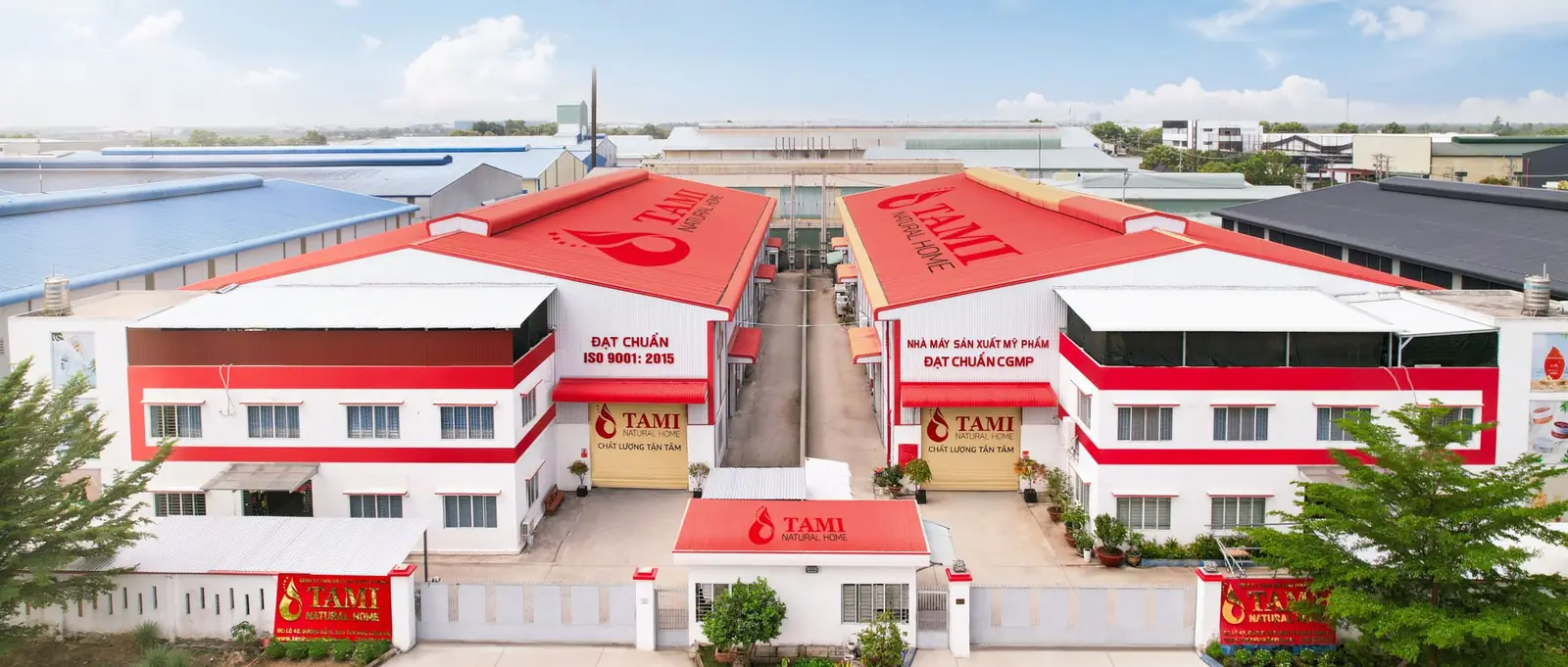
Every position you can walk to: the site, the emulsifying room, the packaging store, the warehouse, the raw-material store and the finished-goods store. You see production as it is running, not a staged sample room. The tour route does not pass through the offices, dormitories or canteen.
Three things are not open: formulations other clients are currently running, other clients’ packaging and artwork, and supplier labels on incoming materials. Not secrecy — that information belongs to other customers.
We have no edited promotional video: if you want to see the lines, see them on site rather than in a recording presented as live. You can ask for this directly when booking — request the running line, not the sample room. A factory comfortable with that usually has reason to be.
Twelve questions to take on site
Write these down and work through them on the day. Every answer here has a reference point on this site, and the list works just as well on any other Vietnamese factory.
- What is the registered company name and tax code? (Ask for the licence itself and check the number on the national business register, not from a verbal answer.)
- Read out the scope line on your ISO 9001 certificate, word for word.
- What is the CGMP number, and when does it expire?
- Is the FDA registration facility-level or product-level, and what period does it cover?
- Which item was your most recent third-party report on, and when? What do the two disclaimer lines on the original say?
- Do you hold a BSCI or Sedex number? If not, how do you take European private-label work?
- Can a batch record be traced to materials and operators? Pull one now.
- How are the raw-material and packaging stores zoned, and who logs temperature and humidity, for how long?
- How many tonnes of purified water a day, and is that enough for my volume?
- What is the smallest emulsifying tank, and which band does my volume land in?
- How many sampling rounds are free, how is round four charged, and when does the clock start?
- Which port do you ship from, and on what Incoterm? (Ours is FOB Cat Lai, Ho Chi Minh City.)
When to conclude the factory is not a fit
Three kinds of request get sent back on day 0 here: the category does not fit the lines, the volume sits below the MOQ, or the target market asks for something we cannot cover. That is our own practice.
Turn the same measure on any supplier you assess. If a factory answers "yes" to everything you ask, do not celebrate — most likely they did not understand, or do not intend to deliver. A factory willing to say "we cannot do this one" in the first conversation makes the remaining yeses worth something.
Our boundaries are set out on what we turn down, including why dry-process colour cosmetics are "makeable but out of scope".
What a quotation must contain
The audit ends on the quotation. Without these fields the price is not comparable — two quotes that look 10% apart often differ on whether packaging is inside the price and whether the port is the same one.
| Field | Why it must be explicit |
|---|---|
| MOQ | kg or units, counted per SKU. Mixing the two is as good as omitting it. |
| Packaging | Inside the price or not; if not, how it is costed and who supplies it. |
| Port | Name the port, not "a Chinese port". |
| Document list | Itemised against the target market, not "standard documents". |
| Delivery milestones | State the start point, not "about X days". |
| Legal entity | Contract, certificates and customs all on the full registered name and tax code. |
These six are also the standard we hold our own quotations to, matching documents we issue.
Specific questions on this piece 5 Q&A
- What documents should a factory audit cover?
- Usually five groups: legal entity (business licence and tax code), certificates, production and QC records, warehouse zoning with temperature and humidity logs, and facility and hygiene control. The list is generic — what differs is whether a factory runs to it day to day or assembles it once an audit is booked.
- How do I verify an ISO 9001 or CGMP certificate?
- The numbers are searchable: ISO certificate 749435 (issued 2024-08-20), CGMP 912/GCN-QLD (issued 2023-12-06). Check three things at once — the issuing body, the issue date, and the scope line. Whether a certificate is still in force is read off the issuing body’s current register, so ask for the latest copy before an audit. An audit that only asks whether a certificate exists has not audited anything.
- Is FDA facility registration the same as FDA approval?
- No. Facility registration only enters the site into FDA’s system as a filing under MoCRA, and FDA never approves a cosmetic formula or product. It also expires: ours started in 2024-03 and has since lapsed.
- Can a European retailer be served without BSCI or Sedex?
- It depends on the channel. Neither is mandatory for cosmetics, but both are often a hard gate in European retailer private-label onboarding. We hold neither and have no third-party social compliance report, so a checklist naming them gets marked "not held". Whether to proceed depends on your channel.
- Does one test report cover the whole batch?
- No. A report covers that one item on that one occasion — the original states that the sample was taken by the client and that sample details were supplied by the client. Read the report date, whether the tested item is the one you are buying, and whether the test methods match your target market.
Every number and date here comes from the plant’s written reply of 2026-10-28 and the original certificates, and can be checked line by line on the certifications page. Credential status changes over time; request the current version before you audit.